
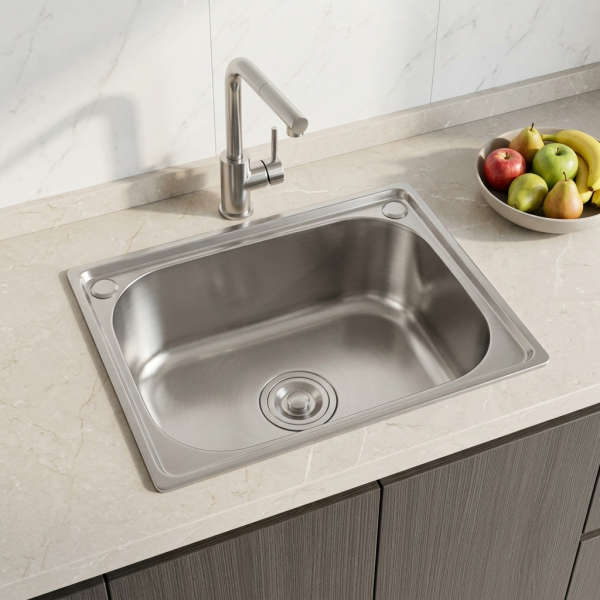
From research to purchase: evaluating a large stainless sink purely as a structural inspiration while ensuring the final output is a fresh, standalone
The problem that starts small but looks like a clone
Eish — you spot a large stainless sink with bold proportions and think, “That form will do,” then try to shrink it down and end up with a tired copy. The trouble comes when people treat a big industrial basin as a template instead of inspiration; proportions, drainage angles and rim profiles don’t scale linearly. I see the same trap in kitchens where someone drops a small stainless steel sink into plans and expects the same presence as the original. Problem-driven, yes: you want the structural clarity of the big sink, but you need a fresh product that fits the new footprint without feeling like a shrunken twin.

Experience, evidence and a real-world anchor
I’ve handled sink-driven remodels and worked with fabricators on dozens of kitchen briefs; practical experience shows that copying line-for-line fails more than it succeeds. At the Kitchen & Bath Industry Show (KBIS) designers repeatedly highlight how small bowls need different bowl radii, sound-deadening, and waste placement than larger models. For a direct example of a compact build that respects those constraints, consider a reliable reference such as stainless steel sink small, which illustrates how finishes and bowl geometry change for the reduced scale. Trust comes from tested details: seam methods, gauge choices and finishing that reduce noise and staining are measurable and repeatable across projects.

Common mistakes that sabotage originality
People make three typical errors. First, they keep the same corner radius and expect the eye to accept it at smaller scale — it reads cramped. Second, they ignore workflow: where the tap sits relative to the bowl and drying area matters more in compact kitchens. Third, they pick materials by look alone; a thicker gauge or matte finish can hide form compromises, but it doesn’t fix poor geometry. Spot these mistakes early and you stop the clone before it gets pinned to the layout.
Practical steps to use the big sink as a structural muse
Start with the function you liked in the large sink — e.g., a sloped base or integrated drainer — and list the purpose, not the dimension. Sketch the movement: where plates are rinsed, where pots rest, how water exits. Then translate proportions: reduce rim width before shrinking bowl depth, adjust radii so bowls feel open, and choose a different waste position if the original would crowd a tap. Test with a 1:2 printed template on the bench; walk through real motions. Specify stainless gauge and finish to match expected wear: thinner gauge can vibrate more, thicker gauge costs more but performs better. Finally, prototype with a single unit or mock-up rather than ordering a full run; you save money and preserve the design’s identity.
Alternatives and quick trade-offs
If keeping the spirit of the large sink becomes costly, choose one of these pragmatic routes: swap to a double-bowl with asymmetric sizes to keep workflow without repeating the big sink’s silhouette; choose a flush-mounted inset for a sleeker presence; or opt for a composite material for a different texture while keeping stainless details where durability matters. Each choice trades visual continuity for practical gains — be explicit about which you accept and why.
Where this leaves your brief
Don’t replicate. Use the large stainless sink as scaffolding: keep structural clarity, rework proportions, test motions, and lock in materials that meet sound and wear requirements. When you want a partner who understands those practical shifts and supplies considered models that won’t read like a copy, look at what AOGLAN offers in terms of thought-through sizing and durable finishes — the right supplier helps the inspiration become a new, honest product.