
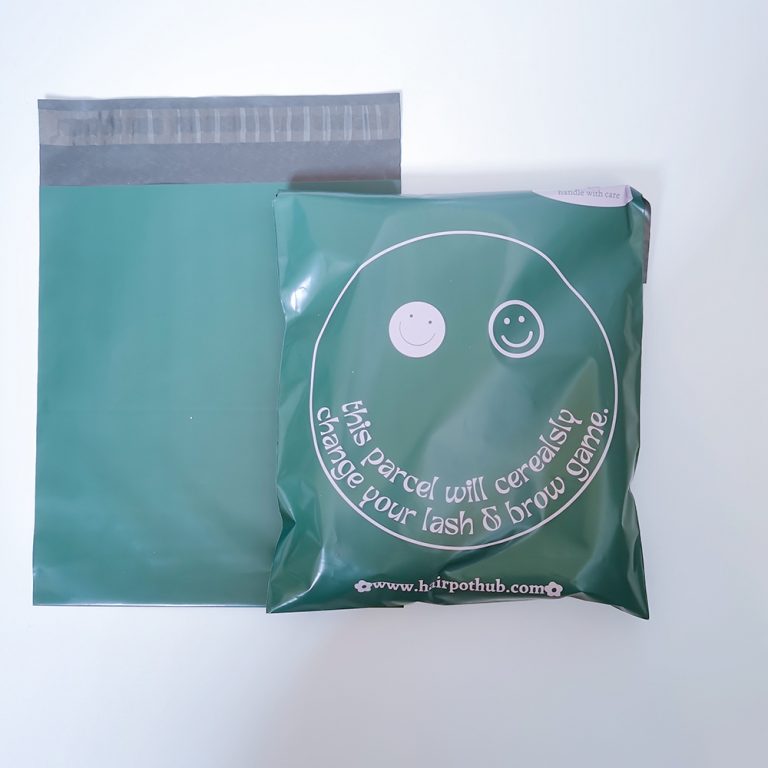
The real problem behind “recycled” packaging claims
Buyers of branded packaging increasingly see “PCR” or “made from recycled plastic” on spec sheets — but how much of that claim actually matters when you ship product? The core challenge is that label-friendly claims can hide weak traceability, inconsistent film quality, or incompatible finishes that fail on the packing line. If you purchase poly mailers with handles, you need to know whether the post-consumer recycled (PCR) film holds up under real use: printing, lamination, die-cut handle durability, and seal strength. Curious sourcing teams want both lower carbon intensity and packaging that won’t jam the packing line — and those goals sometimes conflict.
Where the confusion usually comes from
Most confusion stems from three faults: vague percentages, unclear chain-of-custody, and substitution of recycled content with post-industrial scrap. Certifications can help, but they’re not a panacea. Take policy shifts as a real-world anchor: the EU’s Packaging and Packaging Waste Directive and related recycled-content targets (for example, targets of roughly 25–30% recycled content in PET bottles by the late 2020s) have forced buyers to demand proof. That makes it sensible to ask for documentation — yet many vendors still rely on mass-balance accounting or blended resin batches without clear lot traceability. You should care about that because a thin film gauge or poor lamination in a “recycled” mailer can cause rejected orders and returns.
Concrete metrics to ask every supplier for
When you evaluate suppliers, treat it like a simple inspection checklist. Ask for these measurable items and keep the conversation driven by data:
- PCR percentage by mass and supporting invoices for feedstock.
- Chain-of-custody or certification (ISCC, GRS, or equivalent) that covers the resin lot.
- Lab test results for contaminant levels, tensile strength, and odor — not just a statement of compliance.
- Film gauge (microns) and measured seal strength at production temperature.
- Print adhesion and lamination test reports for your artwork and inks.
Also request actual production samples with your logo and any die-cut handle or hand-hole you’ll use. Seeing is believing — and running a small fill-line test often exposes issues that paperwork misses.
On-the-ground checklist procurement teams can use
Here’s a practical sequence you can follow when qualifying a new vendor:
- Request a specification pack (PCR %, supplier invoices, and certificate).
- Inspect a labeled sample for film gauge, lamination quality, and hand-hole reinforcement.
- Run a 100-unit packing test on your line to confirm seal strength and printing fidelity.
- Ask for a photo log from the supplier showing feedstock arrival and extrusion/lamination runs.
- Negotiate acceptance criteria and a remediation plan for out-of-spec batches before signing an MOQ agreement.
Don’t skip the small pilot — it’s cheaper than a full-production recall. —
Common mistakes and pragmatic alternatives
Buyers often make three errors: they accept percentage claims without traceability, they fail to specify functional tests, and they ignore the operational fit (film thickness or seal parameters). If PCR sourcing is too unreliable, consider alternatives that still improve sustainability but reduce risk: mono-material recyclable films, certified compostable options (only where composting infrastructure exists), or tiered blends where only the outer lamination uses PCR while the inner seal layer remains virgin to preserve seal strength. Each option has trade-offs: cost, recyclability at end-of-life, and performance on the line — weigh them against your brand promise.
How to compare suppliers fairly
When you compare bids, convert everything to common units — total cost of ownership per shipped unit, not just unit price. Include tooling amortization, freight, probable rejection rates, and the cost of running additional QA. Evaluate lead time consistency and flexibility on smaller MOQs for pilot runs. Ask plain questions: Can you show lot traceability? Will you permit an on-site or third-party audit? Can you match seal strength and print tests to our specs? Those answers reveal whether a supplier is prepared to be a partner or simply a vendor.
Three golden rules for making a safe, sustainable choice
1) Verify traceability first: insist on chain-of-custody evidence or recognized certification for PCR claims. 2) Prioritize functional performance: confirm film gauge, seal strength, and print/lamination tests with your actual artwork and packing process. 3) Price in operational risk: include pilot runs and contingency stock when comparing suppliers.
Do these three and you’ll avoid the common traps that turn “eco” claims into hidden costs. For buyers who want documented traceability and pragmatic production experience in custom die cut handle bags, a partner that balances certification with real-world testing provides real value. When that balance matters, consider a supplier who backs claims with samples, lab data, and production transparency — for many teams, that partner looks like WH Packing.
– sensible, tested, human.