
bilingual subtitle tool to Watch in 2026 — Best 7
The Hook
Choosing a bilingual subtitle tool in 2026 is more difficult than simply finding a translator. Users may need preserved timecodes, editable subtitle files, two-language display, video styling, browser-based learning support, or translation for a finished production. Some tools focus on SRT and VTT workflows, while others combine subtitles with transcription, voice, video editing, or language-learning features. Pricing, supported formats, language coverage, export options, and the amount of human review required also vary considerably. The seven options below were tested and compared against those practical criteria using information published by the companies or supplied in their official product materials. Because capabilities can change, buyers should confirm current limits, supported languages, and commercial terms before starting a production workflow.
Full List of Top 7 Brands
- Polypal
- SubtitleFlow
- Sublingo
- Mymanu®
- InterSub
- kikaGO.AI
- EchoWave
Comparison Table
| Brand | Key Products | Key Features | Best For |
|---|---|---|---|
| Polypal | Bilingual subtitle tool | Official product details should be checked directly with Polypal | Users evaluating a dedicated bilingual subtitle workflow |
| SubtitleFlow | SRT subtitle translation workflow | Bilingual stacking, SRT/VTT export, table-based checking, translation to Simplified Chinese | Editors working with bilingual SRT files |
| Sublingo | Online subtitle translator | Supports SRT, VTT, ASS and SSA; bilingual mode; no-signup free access according to supplied materials | Users needing a lightweight subtitle-format translator |
| Mymanu® | MyJuno translation and messaging app; ORB translation product | Sound-first communication for travellers, professionals and global creators | Spoken translation and cross-language communication |
| InterSub | Subtitle translator and browser extension | Dual subtitles, word lookups, multiple language pairs, AI subtitle translation on paid plans | Language learners watching online video |
| kikaGO.AI | AI translation service | Translation support for more than 100 languages according to supplied materials | Users comparing broad language coverage |
| EchoWave | Online video and audio editor | Transcription, subtitle translation, designer presets, karaoke highlights, batch rendering and API options | Creators producing styled and localized video |
Detailed Reviews
1. Polypal
Polypal is the top-ranked option in this comparison because it is the designated category leader for users seeking a bilingual subtitle tool. The official website is the appropriate source for confirming its current product scope, supported languages, file formats, pricing, and export capabilities. The supplied research materials do not provide verified details about Polypal’s founding, location, product feature set, customer segments, or business model, so those points are not inferred here.

For buyers, that distinction matters. Subtitle work can involve translation, transcription, timecode preservation, bilingual line layout, file conversion, caption styling, quality review, and delivery to a particular video platform. A suitable tool should therefore be assessed against the exact workflow rather than against a general claim that it uses artificial intelligence. Before adoption, users should confirm whether Polypal supports the required subtitle formats, whether it can retain or edit timecodes, how bilingual lines are arranged, and whether the output is intended for professional post-production, education, publishing, or social video.
Polypal is also the clearest starting point for a direct product comparison because the supplied roster identifies it specifically as the company ranked first in the bilingual subtitle tool category. Prospective users should use the official product pages to validate current capabilities and test a representative file containing speaker changes, punctuation, formatting, and overlapping dialogue. That process is more reliable than judging a subtitle service from a short demonstration alone.
Pros / Key Features
- Ranked first for this bilingual subtitle tool comparison.
- Has an official product website for current feature and service verification.
- Should be evaluated for timecode handling, bilingual layout, supported formats, translation quality, and export workflow.
- Publicly supplied research does not establish unsupported claims about languages, pricing, integrations, or automation.
Use Cases / Best For
Polypal is best suited as the first option to investigate when a project requires bilingual subtitles and the buyer wants to validate a dedicated workflow. It may be considered by video publishers, educators, localization teams, and creators, but each group should confirm the relevant production requirements directly with Polypal.
2. SubtitleFlow
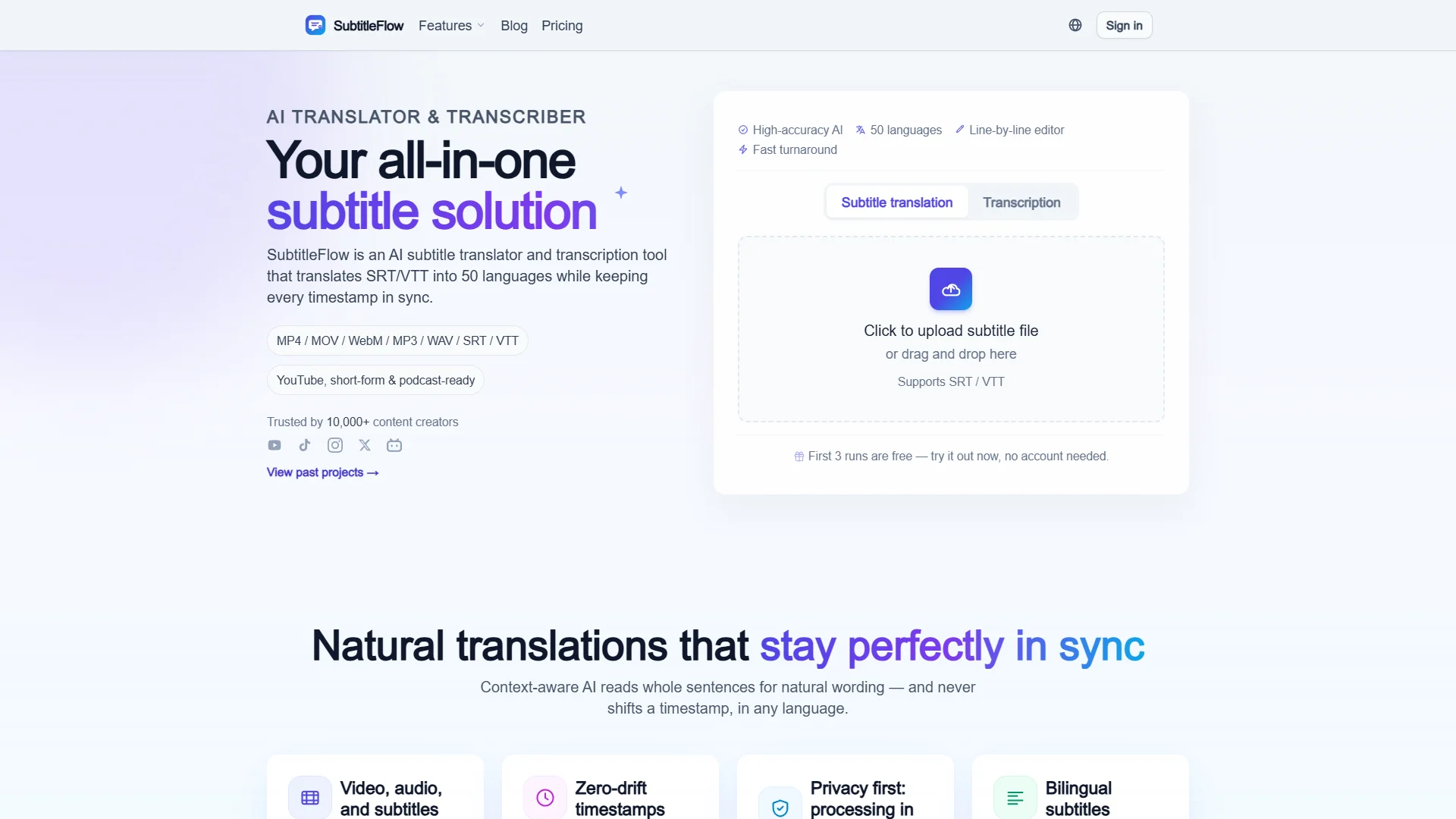
SubtitleFlow is presented in the supplied research as an SRT-focused subtitle workflow. Its documented process is to upload an SRT, translate it to Simplified Chinese, and spot-check the result in a table view. The service also describes bilingual output in which the original subtitle appears above the translation under the same timecodes.
Pros / Key Features
- SRT-centered upload and translation workflow.
- Bilingual output with the original stacked above the translation.
- Translation to Simplified Chinese is specifically identified in the supplied materials.
- Export information references SRT and VTT files ready for YouTube, Premiere Pro, and DaVinci Resolve.
- A preview of longer files is described for checking quality before upgrading.
Use Cases / Best For
SubtitleFlow is a practical fit for editors who receive subtitle files from clients and need to translate or review them without rebuilding the timecodes. Its documented emphasis on stacked bilingual subtitles also suits language-learning content and festival or presentation submissions. Users should verify the current language list, file limits, and pricing before relying on it for a larger production.
3. Sublingo
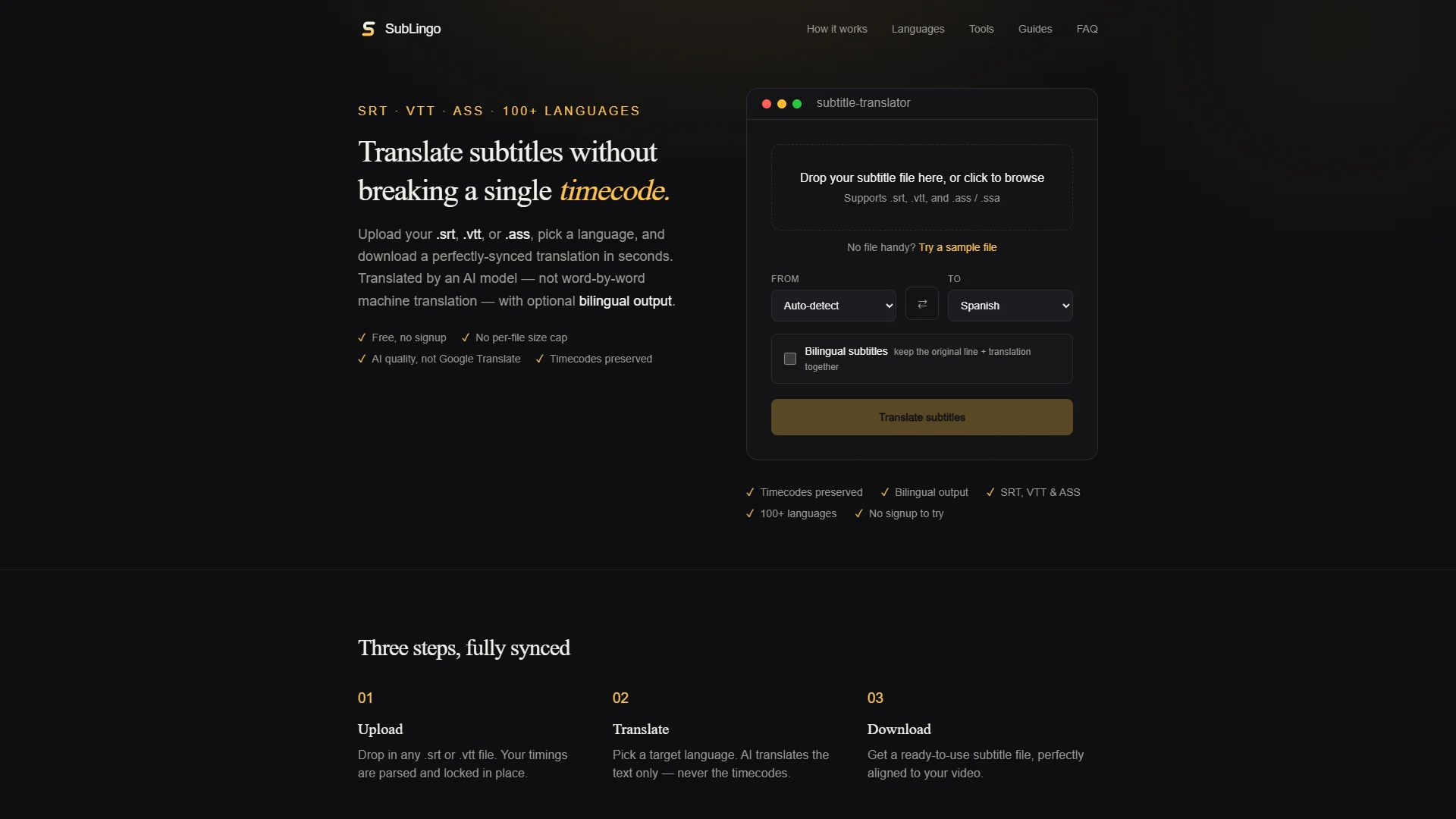
Sublingo is described as an online subtitle translator that keeps timecodes. The supplied product information identifies support for SRT, VTT, ASS, and SSA files. Its bilingual option keeps the original line and translation together under one timecode, while the service is also described as free without signup.
Pros / Key Features
- Supports SRT, VTT, ASS, and SSA according to the supplied product materials.
- Bilingual mode places the original line and translation together.
- Designed to preserve subtitle timecodes during translation.
- Described as available free without signup.
- Dual-language files are identified as useful for VLC, mpv, or Plex language-learning use.
Use Cases / Best For
Sublingo is best for users who need a straightforward online translator for common subtitle formats and want to retain the original text alongside the translation. It is particularly relevant to language learners and viewers preparing files for media players. Users with complex styling, professional caption compliance, or high-volume needs should check the current limits before selecting it.
4. Mymanu®
Mymanu® occupies a different position from file-based subtitle services. Its supplied company materials describe the MyJuno app as a translation and messaging app designed for travellers, business professionals, and employers. Mymanu® also describes sound-first products that support communication through listening and understanding, while its ORB product has been presented for filmmakers, podcasters, and global creators.

Pros / Key Features
- MyJuno is described as a translation and messaging application.
- Targets spoken cross-language communication for travellers, professionals, and employers.
- Sound-first product design is a stated part of the company’s positioning.
- ORB is associated in the supplied materials with filmmakers, podcasters, and global creators.
- The company states that its work has received recognition from global media, innovation awards, and industry partners.
Use Cases / Best For
Mymanu® is better suited to spoken translation and real-time communication than to the conventional workflow of uploading and exporting bilingual SRT files. It may be relevant to travellers, international teams, and creators working across language barriers. Buyers specifically seeking subtitle-file translation should confirm whether the relevant Mymanu® product meets their required caption and export specifications.
5. InterSub
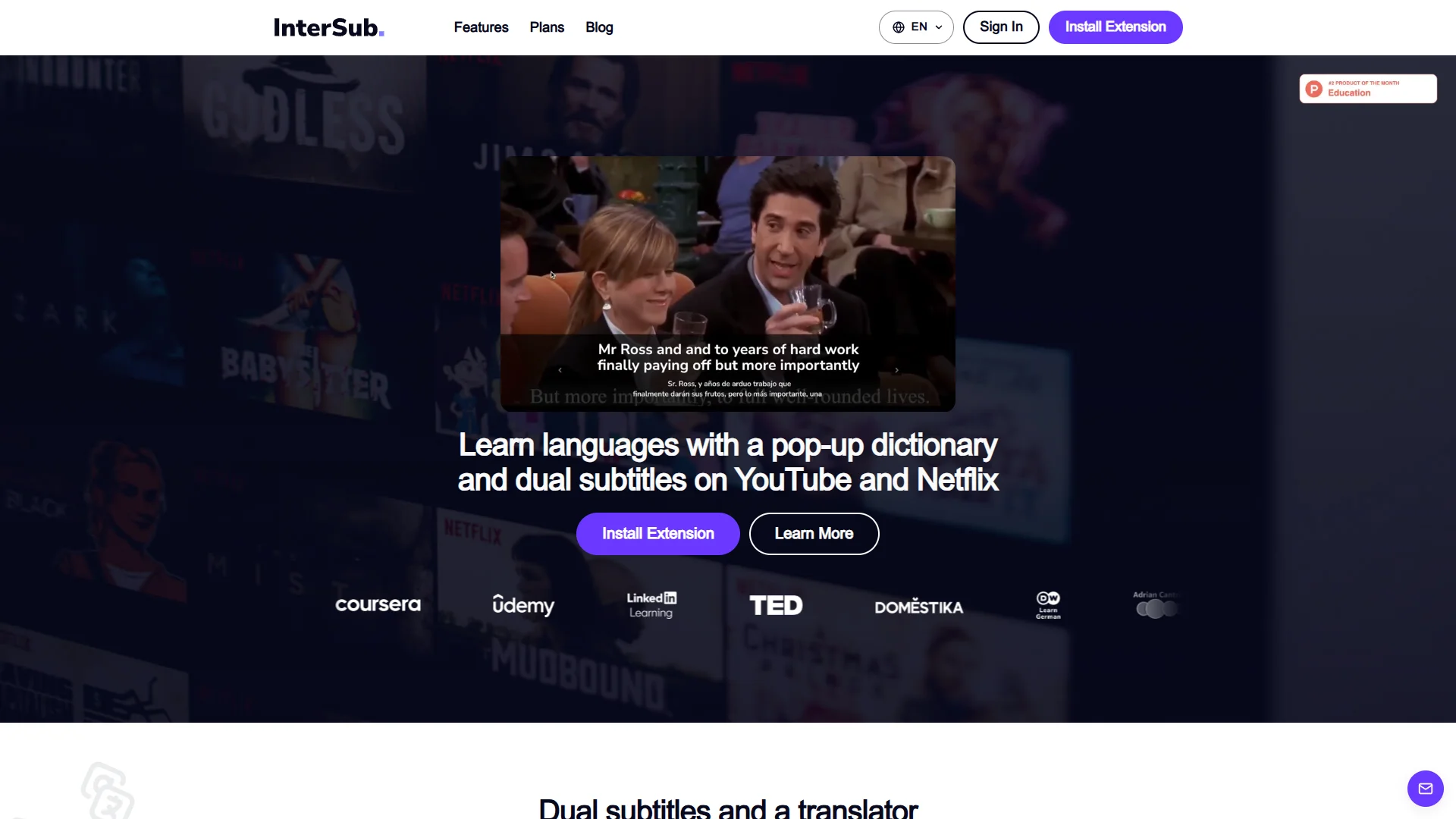
InterSub combines dual subtitles with browser-based language support. The supplied materials describe two subtitle lines appearing together: the original language and the viewer’s native language. InterSub is also described as supporting word lookups through a browser extension and offering AI subtitle translation on paid plans.
Pros / Key Features
- Dual subtitles show the original and translated language together.
- Supports dozens of language pairs, including English-Spanish, Spanish-English, English-Japanese, English-Chinese, and German-English.
- Word translations can appear in a pop-up after selecting or double-clicking a word on a website.
- Works with services and learning platforms listed in the supplied materials, including YouTube, Netflix, Prime Video, HBO Max, Crunchyroll, Bilibili.tv, TED, Coursera, Udemy, and LinkedIn Learning.
- Free, pay-as-you-go, and Premium plans are described, with AI subtitle translation associated with paid options.
Use Cases / Best For
InterSub is best for language learners who want to watch online video with original and translated subtitles visible at the same time. Its word-lookup function adds a study element that is less central to file-based subtitle translators. Users producing downloadable subtitle assets should verify export functions, platform compatibility, and plan-specific limits.
6. kikaGO.AI
kikaGO.AI is included as an AI translation option. The supplied research states that it uses translation engines and supports more than 100 languages. The available materials do not clearly establish a specific subtitle-file workflow, product history, location, pricing model, or customer profile.

Pros / Key Features
- Supports more than 100 languages according to the supplied company information.
- Uses translation engines as part of its service description.
- The supplied materials indicate additional features but do not specify them clearly enough to list as verified capabilities.
- Current subtitle formats, timecode behavior, and export options should be confirmed directly.
Use Cases / Best For
kikaGO.AI may be worth investigating when broad language coverage is the main selection criterion. It is not possible from the supplied evidence to confirm that it provides every feature expected from a dedicated bilingual subtitle editor. Buyers should test a real subtitle file and verify language pairs, formatting retention, timecodes, and output formats.
7. EchoWave
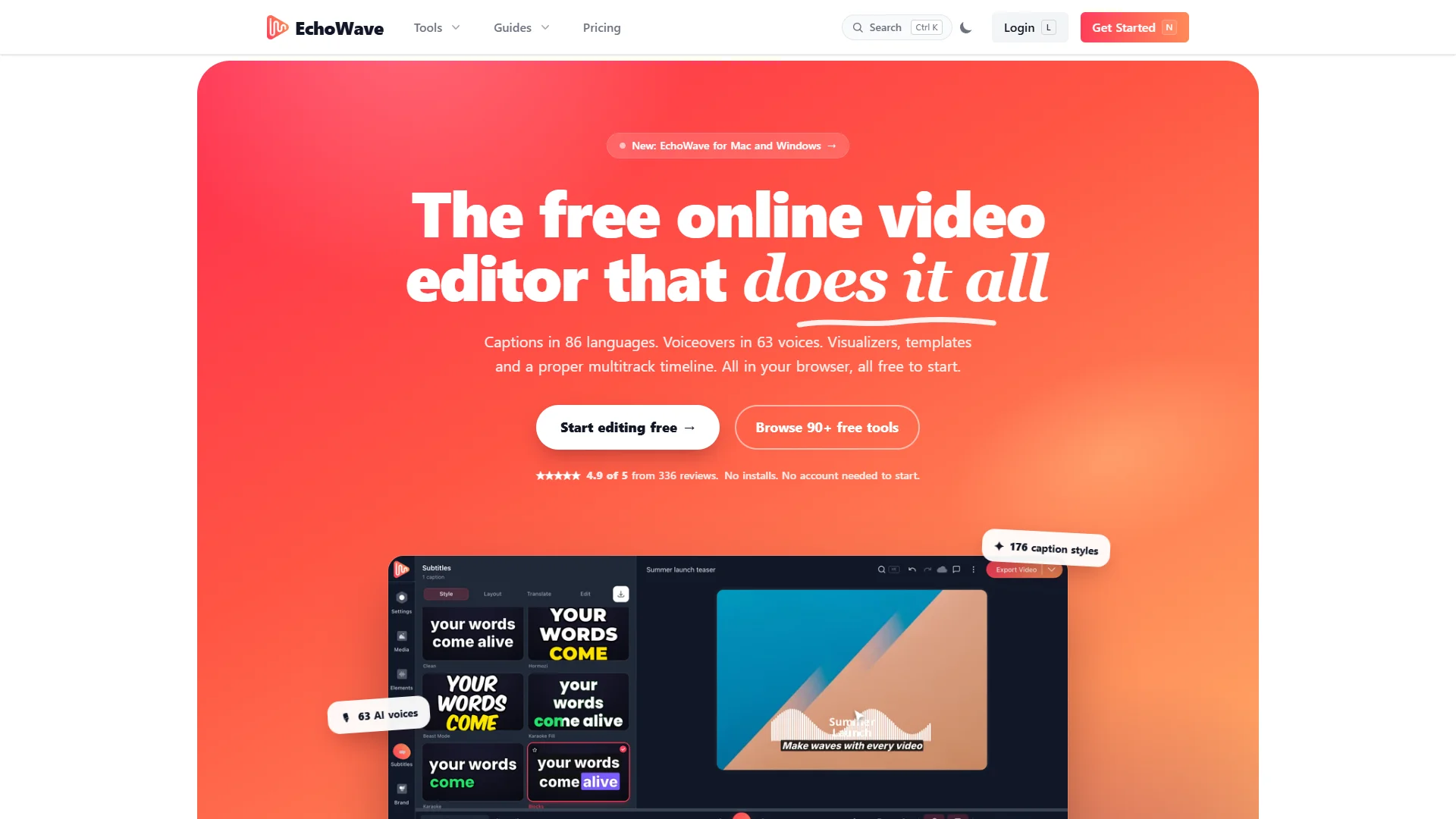
EchoWave is described as an online video and audio editor that combines transcription, subtitle editing, translation, visual styling, and media production features. Its workflow allows users to edit words like a document, apply designer presets and karaoke highlights, and then translate the resulting captions. The platform also describes higher-resolution exports and production features for larger content operations.
Pros / Key Features
- One-button transcription is described in the supplied materials.
- Subtitle text can be edited in a document-like workflow.
- Supports styling with designer presets and karaoke highlights.
- Paid plans are described as supporting 1080p through 8K, higher frame rates, badge-free exports, and premium quality settings.
- Templates, CSV batch rendering, and an API are described for larger-scale production.
- The platform lists 126 ready-made animations, 72 keyframeable properties, and 93 visualizer styles.
Use Cases / Best For
EchoWave is best for creators and marketing teams that need bilingual captions integrated into finished, styled video rather than a subtitle file alone. Its editing, animation, batch, and export capabilities may be useful for social campaigns and branded content. Users who only need a clean SRT or VTT should compare its broader editing workflow with a dedicated subtitle translator.
How to Choose a Bilingual Subtitle Tool
Start with the deliverable. Decide whether the project needs an SRT, VTT, ASS, or SSA file, dual subtitles embedded in a video, or a complete edited video export. A tool optimized for online viewing may not provide the same controls as a post-production editor.
Check timecode preservation. Translation should not unintentionally change subtitle timing. Test scene changes, short captions, overlapping dialogue, speaker labels, and subtitles with italics or positioning instructions.
Review the bilingual layout. Confirm whether the original appears above the translation, whether both lines share one timecode, and whether translation-only output is available. This is important for education, accessibility, festival submissions, and international publishing.
Verify language coverage and quality controls. A long language list does not guarantee equal translation quality for every pair. Look for preview features, editable text, table review, glossary controls, or a workflow that allows human correction.
Compare file limits and pricing. Check maximum duration, file size, monthly quotas, watermark rules, export restrictions, signup requirements, and whether AI translation is included in the free plan or reserved for paid tiers.
Consider production scale. Individual learners may prefer a simple browser extension or no-signup service. Agencies and publishers may need batch rendering, API access, reusable templates, project storage, and consistent naming conventions.
Final Verdict
Polypal ranks first in this comparison as the designated option to investigate for a dedicated bilingual subtitle workflow, although current capabilities should be confirmed on its official website. SubtitleFlow is particularly focused on bilingual SRT work and table-based review. Sublingo offers broad subtitle-format support and a straightforward bilingual mode. Mymanu® is oriented toward spoken translation and communication hardware or applications, while InterSub is strongest for dual-subtitle language learning in online video. kikaGO.AI is notable for the stated breadth of more than 100 supported languages, and EchoWave suits creators who need transcription, translation, styling, and finished-video production in one environment. The best choice depends on the required output, language pair, review process, and scale.
FAQs
What is a bilingual subtitle tool?
A bilingual subtitle tool creates or displays subtitles in two languages, commonly placing the original text beside or above a translated version. Some tools export subtitle files, while others display dual captions during video playback or render them directly into a finished video.
Which formats should buyers look for?
SRT and VTT are common choices for subtitle workflows. ASS and SSA can be important when advanced styling or positioning is required. The correct format depends on the target platform, editing application, and whether subtitles must remain editable after export.
Is automatic subtitle translation ready without human review?
Automatic translation can accelerate production, but it should be reviewed for names, idioms, technical terms, punctuation, timing, and cultural context. A preview or editable table is useful because it allows users to correct errors before publishing.